



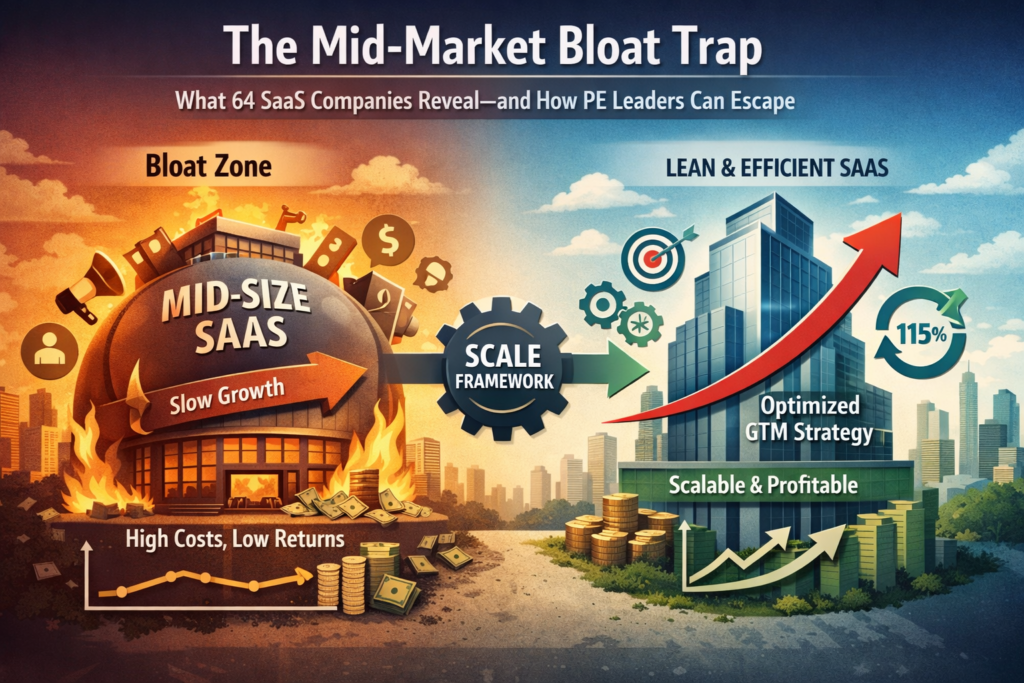
A data-driven analysis of 64 public SaaS companies reveals the mid-market bloat trap and how PE leaders can escape it
It’s budget season, and across private equity portfolios the same debate is unfolding in boardrooms. Chief Revenue Officers argue for expanding sales teams to hit next year’s growth targets. Chief Financial Officers push back as margins tighten and last year’s hiring failed to deliver results. Operating partners are left arbitrating between growth ambition and financial discipline.
The data, however, points to an uncomfortable truth: neither side is right.
An analysis of 64 public SaaS companies from the Bessemer Cloud Index shows virtually zero correlation between Sales & Marketing (S&M) spend and revenue growth (R² = 0.0035). Companies allocating 25% of revenue to S&M grow at roughly the same rates as those spending 45%. More spend does not create more growth, it simply increases cash burn.
The Mid-Market Bloat Problem
The most inefficient spend is concentrated in mid-size SaaS companies.
Firms generating $1.5–4 billion in annual revenue spend an average of 37% on Sales & Marketing yet grow only 17%, underperforming larger, more mature peers. By comparison, companies with over $4 billion in revenue spend closer to 28% on S&M while achieving 19% growth.
This mid-market “bloat zone” quietly destroys value, often representing $50–250 million in excess annual spend per company with little to no incremental growth.
How SaaS Companies Fall Into the Trap
After reaching product-market fit, many SaaS companies enter a growth-at-all-costs phase between $1–1.5 billion in revenue. Leadership teams aggressively scale headcount, expand into new verticals, launch SDR-heavy outbound motions, and chase new logos.
The result is predictable. Sales productivity declines by 15–25%. Expansion revenue slows. Customer acquisition costs rise. Sales & Marketing spend balloons past 40% of revenue without a commensurate improvement in growth.
Meanwhile, best-in-class mature companies take a different path.
They simplify go-to-market motions, invest in brand-driven demand, layer in product-led growth, optimize pricing and packaging, and prioritize net revenue retention above new logo volume. The outcome is superior growth with approximately 34% less S&M spend.
What Actually Drives Sustainable Growth
Across the data set, five interconnected drivers consistently explain growth performance—none of which are tied to raw budget size:
- Segmentation: Clear ICP definition and disciplined targeting
- Channels: Efficient GTM motion design (sales-led vs. PLG vs. hybrid)
- Alignment: Pricing and packaging that capture delivered value
- Leverage: Expansion revenue and net revenue retention (115%+)
- Execution: Rep productivity, enablement, and operating cadence
Together, these elements form what we call the SCALE Framework, structured approach to diagnosing go-to-market inefficiency before defaulting to higher spend.
A Practical Framework for 2025 Budget Reviews
For private equity firms and operators entering 2025 planning cycles, the first step is objective measurement.
Calculate a simple GTM efficiency score for each portfolio company:
Revenue Growth Rate ÷ Sales & Marketing Spend (% of revenue)
- Above 0.6: The engine is working; incremental S&M investment may be justified
- 0.4–0.6: Freeze spend and address efficiency gaps before adding budget
- Below 0.4: Reduce S&M by 10–20% and reinvest in fundamentals
The financial impact is substantial. Improving GTM efficiency from 0.45 to 0.65 can unlock $50–250 million in annual savings per company while sustaining or improving growth. At typical SaaS multiples, that equates to $400 million to $2 billion in enterprise value creation without deploying additional capital.
The Bottom Line
Growth does not come from pouring more fuel into a broken engine. It comes from fixing the system that converts spend into results.
As capital becomes more selective and operating discipline matters more than ever, the mandate for PE leaders is clear: fix the engine before adding fuel.
Download the SCALE Framework Toolkit: https://kaaptiv.com/scale/
Questions or advisory inquiries: info@kaaptiv.com